



 It was when I was 51. Society, due to the severe post-war depression, was stricken by poverty and hardship. Distress and tragedies of all kinds befell people's lives.
At that time I had a responsibility to run Matsushita Electric. That was a big job. However, on the other hand, when I saw such a society full of distress, I wondered why it had happened. I also felt something wrong in the way the government and societal trends were approaching reconstruction. Therefore, besides the job of producing electrical appliances, I, as a human being and a citizen, decided to study this area and begin my PHP research.
Then I had a thought. Why did we have this impoverished society? If we as humankind are destined to be in that situation and can't escape from it then perhaps it can't be helped. But I didn't think that way. I thought otherwise: Humans are naturally endowed with the possibility for limitless prosperity, peace, and happiness. Humans are to be blamed for this impoverished society. They have shed their endowment themselves?they are simply unaware of it.
From this point of view, the undesirable situation in Japan at the time couldn't have been natural. We ourselves were the cause. It could be said that it is mankind's cunning or uncontrollable desire that destroys our society.
We should therefore correct these kinds of attitudes, and if we seek the path toward prosperity, peace, and happiness, then surely we shall find it. This was my way of thinking.
Of course, the path can't be traveled overnight. And the path can't be traveled with only our limited wisdom. However, there are 3 billion humans on this earth. If they can share even a little of their wisdom, we can collect it all together to form a much greater wisdom, or even enlightenment close to that from the heavens. With this aspiration in mind, we started PHP research and the PHP movement.
(Excerpt from the speech for the 22nd anniversary of PHP Institute, Inc. on November 3, 1968)
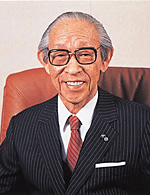
Konosuke Matsushita
(1894-1989)
Founder, PHP Institute, Inc.